Onumba.com – One of the core provisions of the United States constitution is leaving the conduct of elections to the states, thereby creating a very decentralized system.
Some applaud it as a Jim dandy idea that has served the country well. Perhaps, nowhere is this glowing review more visible than in the area of safeguarding electoral integrity to prevent hacking or rigging of election outcomes.
But while both Democrats and Republican lawmakers love the decentralized system, President Trump isn’t feeling it.
The president is calling for a change.
If you don’t mind, please log that into the spreadsheet tracking the draconian things Trump is eyeing to accomplish ——— annexing Canada as the 51st state and the rapacious seizing of Greenland in Europe ——— being at the top of his wacky wish list. However, it’s all wishful thinking anchored on his usual bombastic pomp. Federalizing elections, which would be a near Sisyphean endeavor, is not going to happen, either.
Recently, President Trump called for nationalizing elections, suggesting that Republicans should “take over and nationalize elections.”
Trump in his own words: “Republicans should say, we want to take over. We should take over the voting, the voting in at least as many as – 15 places. The Republicans ought to nationalize voting.”
But in a rare show of bipartisanship, both Democrats and Republican lawmakers are having none of it. They are fiercely pushing back and expressing the view that a decentralized system has worked well for the country, if only for the obvious fact that hacking or rigging 50 systems is harder than one.
When on January 2, 2021, Trump phoned Georgia Secretary of State Brad Raffensperger desperately pestering him to find “11,780 votes” to overturn his loss to Democrat Joe Biden in the 2020 presidential election in that state, it was a jaw-dropping moment that could live in electoral infamy. Think for a moment how unhinged it would look phoning all 50 Secretaries of State hounding them for cheat votes.
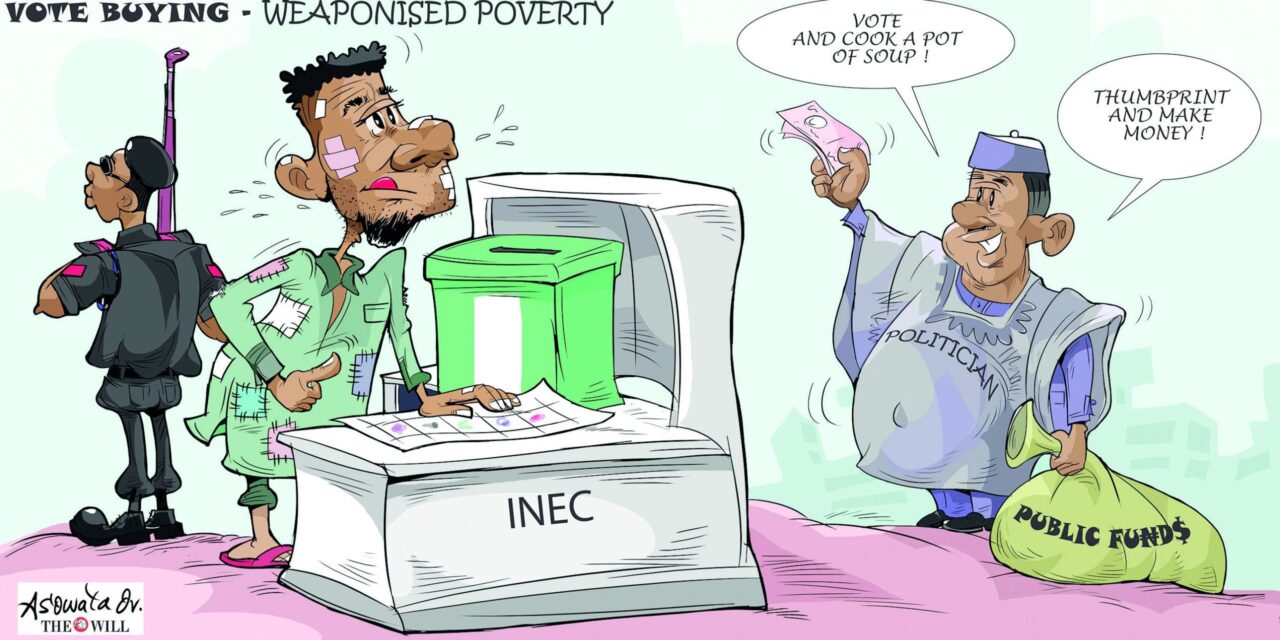
All of which got me thinking about Nigeria where one entity, Independent National Electoral Commission (INEC) — oversees all elections, charged with upholding a free and fair process. Voter registration, ballot counting, fraud prevention and announcing the winners, all fall under the jurisdiction of INEC whose chairman is appointed by the president. By who? You heard me right. The president.
Not surprisingly, the outcome of several elections in Nigeria reflects that staggeringly defective structure. For the most part, conducting free and fair elections there has been elusive, often leading to cantankerous outcomes and contests punted to the court where accusations and counter accusations of rigging and all ilks of election shenanigans would be flying higher than a homemade kite flown by a Bogoro village boy.
Would a decentralized system as in the United States be a good fit for Nigeria?
Nigerian immigrant and Professor of Sociology at Grandview University in Iowa Amadou A. Baba-Singhri isn’t so sure.
Dr. Baba-Singhri noted that “corruption is about power of money and authority,” arguing that the states and the federal government reflect two sides of the same coin ——– similarly blemished in a country where the “end justifies the means.”
“Thus, I am not sure whether the question of decentralization is meant to suggest that the state executive political leaders may be less corrupt than the federal government.”
“I am not really sure if that’s a strong argument.”
But Dr. Chukwudi Mgbatogu of Nigeria, also in sociology academia, feels differently ——– favoring a “localized” system.
“I am of the view and firm belief that all elections in Nigeria should be localized,” he said, in a statement.
Dr. Mgbatogu is strongly opposed to “one man, the incumbent president” wielding the constitutional power to appoint the chairman of INEC whose job it is, not only to conduct free and fair elections, as difficult as that is, but also to certify and announce the outcomes.
It is a visible conflict of interest that “does not augur well for our nascent Democracy”, he argues.
“At the end of the day, the chairman of the electoral body that was appointed by the incumbent president must favor his benefactor.”
Contact the writer at: onumbamedia@yahoo.com.