By Chiamara Anyacho
Contributing Writer
Onumba.com ———- Imagine funding a government agency that does not exist.
Then somehow getting an office for it inside the Federal Secretariat in Abuja.
Then having government institutions communicate with you as though you are actually a government official.
Then having the agency appear in the 2026 national budget with about ₦1.3 billion allocated to it.
At this point, you are probably asking the same question I asked:
HOW?
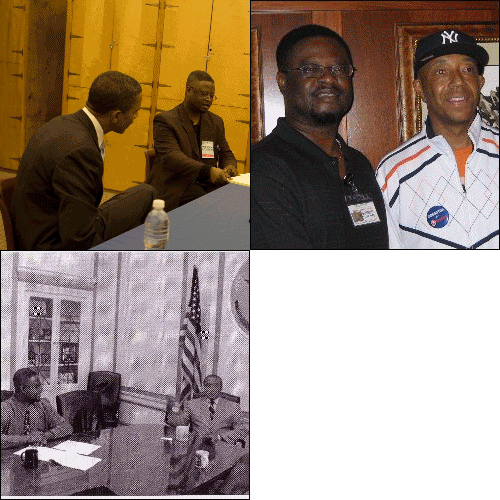
I present to you: Adeniyi Adeyemi. The mastermind behind this forgery.
And according to the Nigerian government and investigators, Adeyemi allegedly presented himself as the Director-General of something called the Presidential Foreign Investment Promotion Council, PFIPC.
The problem?
The government says the agency did not exist.
The Independent Corrupt Practices and Other Related Offences Commission, ICPC, said its investigation found that Adeyemi was never appointed by the Federal Government and that the purported agency was not created by any law, Executive Order or other valid government instrument.
But somehow, this “non-existent” agency was operating from an office inside the Federal Secretariat Complex in Abuja.
It had official-looking documents.
It allegedly had a website and social media platforms.
And documents presented to government institutions made it appear legitimate.
Nobody said, “Wait o, who created this people?”
Well, eventually, somebody did.
The controversy reportedly started after concerns were raised about the activities of the purported agency, eventually leading to investigations by the police and ICPC.
And then came one of the craziest parts.
The purported agency appeared in the 2026 Appropriation Act with an allocation of about ₦1.3 billion.
Yes.
₦1.3 BILLION.
But before we start shouting that somebody collected ₦1.3 billion, let’s be accurate.
The ICPC said its investigation found no evidence that Federal Government funds were actually approved or disbursed to PFIPC or its operators.
So the shocking part isn’t necessarily that a fake agency collected ₦1.3 billion.
It is that an organisation the government now says was not legally established still made its way into the budget.
How?
I also want to know.
And it gets even more interesting.
According to the ICPC, the investigation uncovered two other purported fictitious agencies allegedly linked to Adeyemi.
The FCT Investment Promotion Agency.
And the Foreign Investment Promotion Agency and Public-Private Partnership.
Investigators also alleged that forged documents were used in connection with these organisations and attempts to operate bank accounts in their names.
Then there were the alleged forged appointment letters.
One of the charges against Adeyemi concerns an appointment letter purportedly issued by President Bola Tinubu and signed by then Chief of Staff Femi Gbajabiamila.
The prosecution says the document was forged.
Adeyemi has pleaded not guilty to the charges.
And today, September 30, 2026, the case took another turn.
Adeyemi was arraigned before the Federal High Court in Abuja.
He pleaded not guilty.
The court ordered that he be remanded in Kuje Correctional Centre, with the matter adjourned to October 12 for further proceedings.
Adeyemi has maintained that PFIPC is legitimate and has denied wrongdoing.
So, as things stand, the court still has to determine the criminal allegations against him.
But honestly…
HOW DID A GOVERNMENT AGENCY THAT THE GOVERNMENT SAYS DID NOT EXIST GET THIS FAR?
An office.
Government correspondence.
Government processes.
Budget appearance.
Requests to other government institutions.
And allegedly, attempts to open accounts with the Central Bank.
At what point did somebody look at all these documents and say:
“Oga, who send you?”
That, to me, is the bigger story.
Because one man allegedly presenting himself as a government official is one thing.
But the fact that the alleged scheme was able to move through multiple layers of bureaucracy before being exposed raises a completely different question about verification and oversight.
How did the system allow the agency to look real for so long?
About writer: Chiamara Anyacho is a passionate writer known for crafting compelling and impactful content. She specializes in professional writing services including CVs, Statements of Purpose, grant proposals, and scholarship essays, helping individuals present their stories with clarity and distinction. Her work spans poetry, thought provoking articles, and captivating short stories that explore human experiences and societal realities. She has received notable recognition including an Honorable Mention in the National Economic Summit Group’s Essay Competition, the Honorable Mention Award at the Literesque Prize 2026, and reaching the penultimate stage of the Pen on Fire Stages Competition.
Share and let us know what you think in the comment section below.